In the oil and gas industry, building pipeline systems involves more than just laying pipes. It includes the integration of vital components such as fittings, flanges, valve bodies, and pump casings. These components are primarily manufactured using two fundamental techniques: forging and casting. Each method not only differs in its manufacturing approach but also offers unique advantages in terms of strength, reliability, and safety.
 Forging – Strength and Consistency
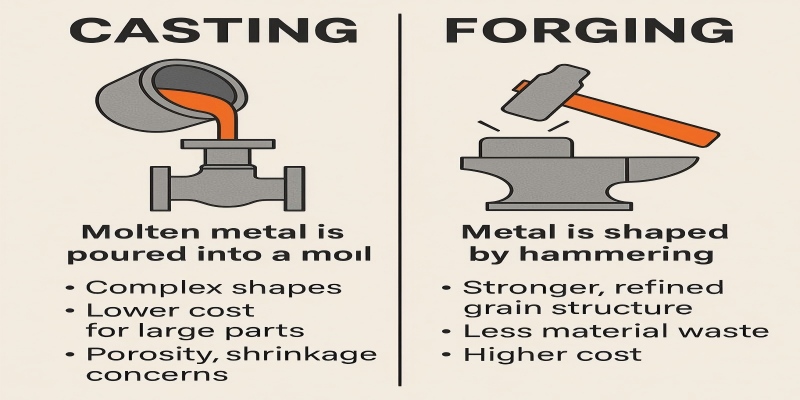
Forging involves heating metal to a specific temperature and then shaping it under mechanical pressure. This process retains the metal’s parallel grain structure, resulting in high strength and minimal porosity, making it ideal for components that need to withstand high pressure.
Commonly used forging materials include:
- ASTM A105: Forged carbon steel used for flanges, fittings, and valve components.
- ASTM A350 LF2: Forged low-temperature carbon steel suitable for low-temperature applications.
- ASTM A182: Forged alloy used to produce F11/F22 (Chromium-Molybdenum steels) and F304/316 (stainless steels).
Relevant standards:
- ASME B16.5
- ASME B16.47
- ASME B16.11
Examples of forged products:
- Flanges (such as weld neck and blind flanges)
- Forged fittings (socket weld and threaded)
- Branch fittings (like Weldolets and Sockolets)
- Valve components (valve stems and seats)
- Shafts
 Casting – Complex Shapes and Cost Efficiency
Casting involves pouring molten metal into pre-designed molds where it cools and solidifies into complex shapes. This method is cost-effective but carries higher risks of porosity and shrinkage defects.
Commonly used casting materials include:
- ASTM A216 WCB: Cast carbon steel used for valve bodies and flanges.
- ASTM A352 LCB/LCC: Cast low-temperature carbon steel for low-temperature environments.
- ASTM A217 WC6/WC9: Cast chromium-molybdenum steel suitable for high-temperature or steam environments.
- ASTM A351 CF8/CF8M: Cast 304/316 stainless steel for manufacturing pump casings and valves.
- ASTM A995 4A/5A/6A: Cast duplex/super duplex stainless steel for seawater applications.
Relevant standards:
- ASME B16.34 (valves)
- API 598 (testing)
- MSS SP-55 (visual inspection)
Examples of cast products:
- Valve bodies and covers
- Pump casings and impellers
- Wide flange beams
- Complex reducers and tees
- Compressor casings
 Abbreviations Explained:
- WCB (Carbon Steel Grade B) → ASTM A216
- LCB/LCC (Low-Temperature Cast Carbon Steel) → ASTM A352
- WC6/WC9 (Cast Chromium-Molybdenum Steel) → ASTM A217
- CF8/CF8M (Cast Stainless Steel) → ASTM A351 SS304/316 equivalent standards
- 4A/5A/6A (Cast Duplex/Super Duplex Stainless Steel) → ASTM A995
Forging and casting are indispensable manufacturing techniques in the oil and gas industry, each with its distinct advantages and suitable applications. The choice of the right manufacturing process depends on specific application requirements, cost considerations, and design complexity. This knowledge can greatly aid in ensuring the durability and efficiency of the components used in high-stakes oil and gas projects.